
Lactate you can act on: Using numbers to adjust tomorrow’s session
Coaches tend to agree on one point: data only matters if it changes behaviour. Lactate earns its place in training by being precise of course, but above all by being decisive. Its real value lies in helping athletes and coaches answer a near-term question: should tomorrow’s session stay as planned, be adjusted, or be replaced altogether?

When should lactate override the plan?
Lactate becomes especially informative when it contradicts expectations. Elevated values at low or moderate power or pace often indicate incomplete recovery, dehydration, or accumulated fatigue, even when perceived exertion feels normal. In these cases, pushing ahead with the planned workload rarely produces the intended adaptation.
During interval sessions, persistently high lactate combined with poor clearance between repetitions suggests that either intensity is set too high or recovery is too short. The session may still feel achievable, but its cost is disproportionately high.
Pairing lactate with other signals
Lactate is most informative when interpreted alongside power or pace and heart rate. A common red flag is usual output with unusually high lactate, an indication that internal load has changed even if external metrics look stable.
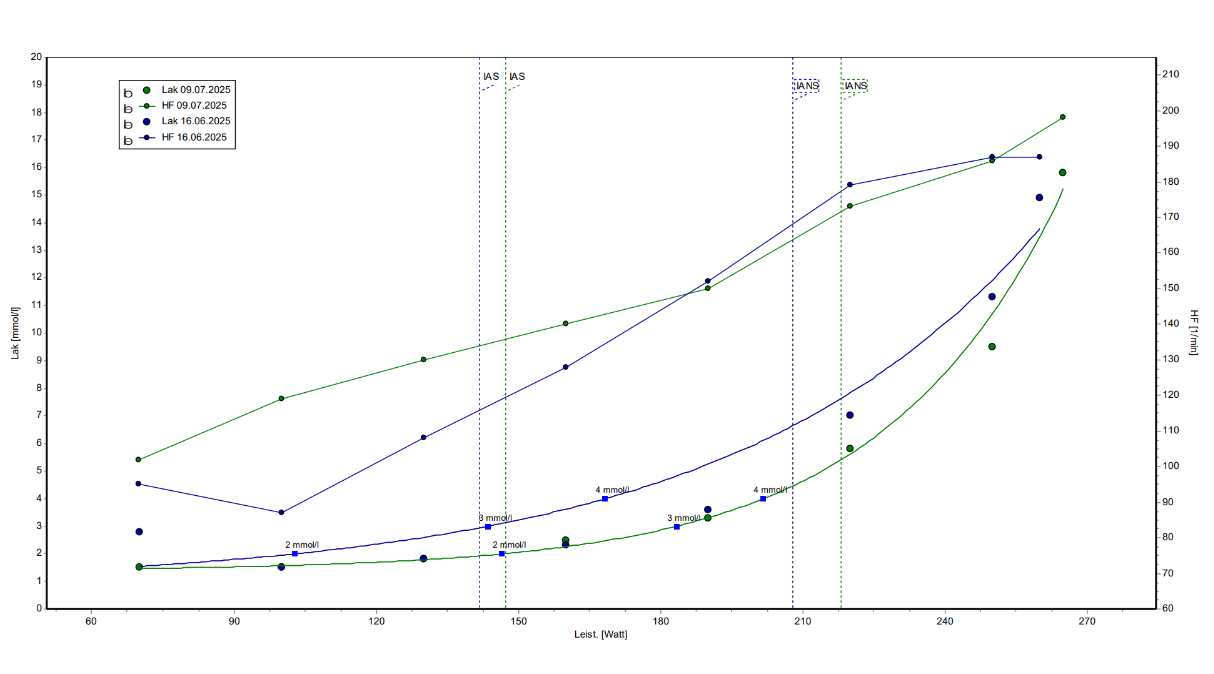
Signal versus noise: what deserves a response?
Not every fluctuation should trigger a change. Single-point measurements can be influenced by sampling timing, hydration status, or short-term stress. What matters is pattern, not perfection.
Useful signals tend to share three characteristics:
Lactate is consistently higher than expected at a familiar power or pace.
The deviation appears across more than one session.
Clearance between efforts is slower than usual.
Isolated spikes, by contrast, often resolve without intervention.
Keeping it simple
Coaches do not need complex models. Simple rule-based logic, if lactate exceeds an increase of X at Y power, flagging the session, is often enough.
Takeaway
Measure lactate with the intent to act, but act on patterns, not on individual data points. A single elevated measurement is noise; the same reading across 2 or 3 sampling points (within a session) is a signal worth adjusting for. If it doesn’t influence the next decision, it’s probably not worth collecting.
The next article shifts from individual decisions to the realities of testing and coaching whole squads.